Local relining guide
When relining is the right answer around Richmond
On a long run, excavation is the expensive option
An excavation quote and a relining quote can look close together until you notice how many metres are involved, and on acreage the run from the house to the street or the tank is long.
Every metre of trench is machine time, spoil to move, and reinstatement afterwards, and none of that scales kindly.
So the gap between the two methods widens with distance, and out here the distance is the defining feature.
The house-to-tank line deserves attention
On an unsewered property, everything between the house and the tank is private pipework carrying the whole household's waste over a considerable distance.
It is the least considered piece of plumbing on most of these properties and one of the more consequential ones, because a failure in it affects everything.
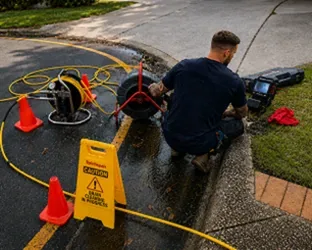
It films exactly the same way as any other line, and it is worth knowing the condition of rather than assuming.
Roots come through joints, so remove the joints
Older earthenware sewer is laid in short lengths with a joint between each one, and the joints are where the ground has been working and where roots enter.
Cutting roots clears what is inside today and leaves the opening exactly as it was, which is why the interval between clearances keeps shortening.
A cured liner removes every joint along the run, which addresses the cause rather than the symptom.
After a flood, expect silt before you expect a collapse
Floodwater carries a large amount of fine material, and where it has entered a drainage system that material settles in it.
So a line that stopped working after a flood is frequently silted rather than damaged, and that is a considerably cheaper problem.
The camera separates the two, which is worth doing before anybody quotes structural work on a line that simply needs cleaning.
What relining actually is
A resin-saturated liner is drawn into the existing pipe, inflated against the inside wall and cured in place, forming a new pipe inside the old one.
Continuous, smooth, slightly smaller in bore and structural in its own right rather than a coating.
It goes in through existing access, so a paddock, a driveway or a long lawn does not have to be opened along its length.
Relining does not suit every pipe
A liner needs a host pipe with enough structure left to cure against. A collapsed section, or one that has lost too much wall, has to be excavated and replaced.
Grade is the other one. A pipe can be intact and still fail because a section has settled, which on floodplain ground is a real possibility.
Both are visible on camera in seconds, which is why the survey comes before the quote rather than after.
A short replacement plus a liner is normal
Where one length has failed, that section gets replaced and the rest gets lined. On a long run that is a very different proposition from trenching the whole distance.
It keeps the excavation to one place, which on acreage with a driveway or established planting over the line matters a great deal.
A quote presenting it as one method or the other is selling a method rather than solving a problem.
Junctions get reopened after the liner cures
The liner passes over each branch connection on the way in and each is cut back open from inside once the resin has set. Routine, and confirmed on camera.
A missed one stops the branch it serves draining, which is immediately obvious rather than hidden.
You keep the after footage, which is how you confirm the junctions are open rather than taking anybody's word for it.
What the camera tells you beyond the repair
Where the line actually runs, which on a large block nobody has ever documented, and how far it is from the house to the tank or the street.
That is worth having on file independently of any repair, particularly before landscaping, building or any other work that involves digging.
The recording is yours whatever it shows.
Why we quote both ways
You should be able to compare, so both figures come together for the same defect, with the length in metres and what each includes for reinstatement.
On acreage, ask the excavation quote specifically about access for a machine and what happens to the ground it crosses.
If a quote offers only one method, ask what the other would cost.