Sewer or septic? Out here that question decides the whole job. On an unsewered block a backup is very often the system rather than the pipe, and clearing a clear line costs you money without fixing anything.
Online Now!·--:--
Most plumbing advice quietly assumes your waste leaves the property. Across a good deal of the Hawkesbury it does not, and that changes the diagnosis before anyone looks at a pipe.
On a sewered block the logic is simple. Everything you flush goes to the main, so when it stops going, something is in the way: roots through a joint, wipes, fat, or a section that has failed. Clear the obstruction and the problem is over.
On an unsewered block the waste stays with you. It goes to a tank, gets treated to some degree, and then has to soak away through a disposal area on your own land. Every one of those three stages can be the thing that has stopped, and none of them are in the pipe. A tank overdue for pumping, a failed pump, or ground so saturated that the trench cannot take another litre will all present at the toilet exactly like a blockage.
Which is why we ask sewer or septic before anything else. Sending an eel down a line that was never blocked is a bill for nothing, and it is the single most common way people here get charged twice for one problem.


Stop using every fixture on that line. Then tell us whether you are on sewer or on a tank, because it changes what we bring and occasionally who you actually need.
Plenty of people in this district genuinely do not know, particularly if they have bought recently. Look for one or two lids set into the ground somewhere in the yard, or a treatment unit with a small blower running. Either means the waste stays with you.
It is worth establishing on a quiet afternoon rather than at the point the toilet will not flush, because it determines who you should be ringing. Some of what goes wrong out here is a plumbing job and some of it is a pump-out or a service visit.
When a septic tank fills past its working level, there is nowhere for the next flush to go, so it backs up toward the house. The line between the house and the tank is entirely clear the whole time.
A conventional tank generally needs pumping out every three to five years depending on size and household. If nobody can tell you when yours was last done, assume it is due. That check costs far less than an emergency at 11pm.
Effluent leaving the tank has to soak away through absorption trenches or an irrigation field. That only works if the surrounding ground can accept water.
After a genuinely wet stretch it cannot, and the whole system backs up behind it. Sometimes it recovers on its own once things dry out. Sometimes the disposal area has simply reached the end of its life, or the household has grown beyond what it was sized for. Effluent surfacing at the ground is a health issue and should be dealt with rather than watched.
An aerated wastewater treatment system is a more involved arrangement with a blower, usually a pump, and moving parts that wear. In New South Wales it operates under an approval from Council and carries a servicing requirement, normally quarterly by an accredited servicing agent.
That is a condition of the approval rather than optional maintenance. It also happens to be the thing that catches a failing pump before the failure reaches your bathroom, which is the practical reason to keep it up.
Where the property is connected, the usual suspects apply: roots finding a weeping joint in older earthenware, wipes that were never going to break down, fat that set as it cooled, or a section that has cracked.
The difference in this district is simply that we do not assume it. A camera on a repeat blockage tells you which of those you have, and on a rural block with a long run to the street it is usually worth the money the second time it happens.
Quoted at a fixed price before it starts. These are indicative 2026 Sydney ranges. On an unsewered property we establish whether the system or the line is at fault before quoting, because occasionally the honest answer is that you need a pump-out rather than a plumber.
Hand tools or an electric eel through an existing access point. Most one-offs land here.
Mechanical cutting back to clean pipe wall, priced on how much is actually in there.
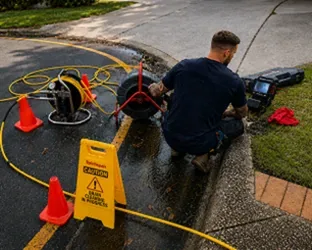
Down the line with the footage handed over, so you can see what is happening.
High-pressure water where an eel will not do it, or to flush after cutting.
Issued with the footage. Useful for a buyer, an insurer or a Council conversation.

The question that decides everything after it. On a tank we ask when it was last pumped out, because that alone often explains the whole call.

We work from the closest existing access point so nothing backs up through the house while the line is being cleared.

Roots, a collapse and a system that is simply full look nothing alike on screen. On a repeat, this is the step worth paying for.

Including when the answer is that the line is fine and what you actually need is the tank emptied or the system serviced.
Stop using every fixture on that line, the washing machine included. Then tell us sewer or septic, it changes what we bring.
Call 1300 381 569
It is the first thing we ask on any Hawkesbury drain call, and a surprising number of people are not certain. It matters because the two fail completely differently. On a sewered property, everything you flush leaves the block, so a backup means something is obstructing the line. On an unsewered property the waste stays on your land in a tank and a disposal area, and a backup very often means that system is full, saturated or not working, with the line itself perfectly clear. Clearing a clear pipe fixes nothing and you have paid for it. If you are unsure, look for a lid or two in the yard and tell us what you find.
On a septic property that is the classic pattern and it points at the system rather than the pipe. The usual causes are a tank that is overdue for pumping out, a pump that has failed in a system that relies on one, or an effluent disposal area that has stopped absorbing. That last one is common after a genuinely wet stretch, because a trench or irrigation field cannot take water away when the ground around it is already saturated. None of those are solved with an eel down the line, which is why we ask before we bring one.
As a general guide every three to five years for a conventional septic tank, though it depends heavily on tank size and how many people are on it. An aerated system is a different arrangement: in New South Wales those carry an approval to operate from Council and a servicing requirement, normally quarterly by an accredited servicing agent, and that servicing is a condition rather than a suggestion. If you have moved into a property and have no idea when either was last done, that is worth finding out before it announces itself.
Yes, and it should not be left. Effluent surfacing is a public health matter, not an inconvenience, and it means the disposal area is no longer doing its job. Sometimes the cause is temporary, a very wet period with saturated ground, and it recovers. Sometimes the trench or field has reached the end of its working life, or the household load has grown past what it was designed for. Either way, keep people and animals off it and get it looked at rather than waiting to see whether it dries out.
No, and on a septic system they are worse than on sewer. They clear the S-bend, which is the whole of what the label promises, then fail to break down. On sewer they become somebody else's problem downstream. In a septic tank they simply accumulate, take up volume that should be holding liquid, and shorten the interval between pump-outs considerably. The same goes for anything else that does not break down: cat litter, sanitary products, paper towel.
Rarely, and on a septic system they are actively harmful. A septic tank works because of the bacteria living in it, and caustic drain cleaner poured down the toilet arrives in that tank and kills them. The system then stops digesting solids properly, which shows up weeks later as a problem that looks unrelated. On sewer they are merely ineffective and make the water we have to work in dangerous. Either way, if something has been poured down, tell us when you call.
Most clears through an existing access point are $150 to $400. Root cutting is $400 to $900 depending on how much is in the line. A camera inspection is $250 to $450 with the footage handed over. On an unsewered property we will usually want to establish whether the system or the line is the problem before quoting anything, because that answer changes the job completely and occasionally means the right call is a pump-out rather than a plumber.
Tell us whether you are on sewer or on a tank, and whether this has happened before. On an unsewered block those two answers usually identify the problem before we arrive.
Fixed price agreed before we start, including when the honest answer is not a plumbing job.
Online Now!·--:--